01
Step 01
Source
Documents, notes, plans, specs, links or structured files give Nolta the raw material for a new universe.
Blueprints
Blueprints are reusable work patterns for Nicky-assisted universe creation, scoped AI work and human-reviewed change.
They help Nolta understand what kind of work it is looking at, how it should become a living universe and what should be reviewed before anything becomes trusted context.
The Blueprint keeps the universe scoped and reviewable.
Not a static template
A template copies a shape. A Blueprint helps define how a type of work should be understood, created, used and reviewed over time. It separates the generic Nolta engine from the domain-specific language that makes a universe useful.
Step 01
Documents, notes, plans, specs, links or structured files give Nolta the raw material for a new universe.
Step 02
A reusable work pattern tells Nolta how this kind of work should be interpreted, structured and reviewed.
Step 03
Nicky applies the Blueprint, asks the necessary questions and proposes Universes, Galaxies, Planets, Satellites, links and gaps.
Step 04
Humans review, edit and approve before Nolta creates trusted context and records how the universe was born.
Assisted universe creation
Nolta can start from existing knowledge: documents, plans, research files, creative briefs, technical scope or structured imports. Nicky reads the source, applies the active Blueprint and proposes how the work should become a universe.
The proposal can include Universes, Galaxies, Planets, Satellites, links, missing questions and alternate structure choices. The user reviews the proposal before Nolta creates trusted context.
Persistent governance
This is the important part: Blueprints are not only creation helpers. They keep the universe aligned with the work it represents. They guide context preparation, scope, evidence expectations and review.
That prevents AI work from becoming a giant free-for-all prompt box. When requested work does not fit the current context, Nolta should explain the mismatch and guide the user toward a better action.
Blueprint gate
Missing documentation, wrong scope, weak evidence or irrelevant requests should be surfaced before AI work begins.
Scope before work. Evidence before trust.What a Blueprint controls
The same Blueprint that helps Nicky create the universe should later help Nolta decide what context is relevant and what review is required.
Structure
A Blueprint describes which structures are allowed, what Galaxies and Planets should represent, and which choices require confirmation.
Context
It guides which context is relevant, what may be missing and what should be reviewed before AI work starts.
Execution
If a request does not fit the active Blueprint, Nolta can guide the user toward a better scoped action before work begins.
Review
Blueprints can define evidence expectations, review requirements and proposal gates before approved changes become part of the record.
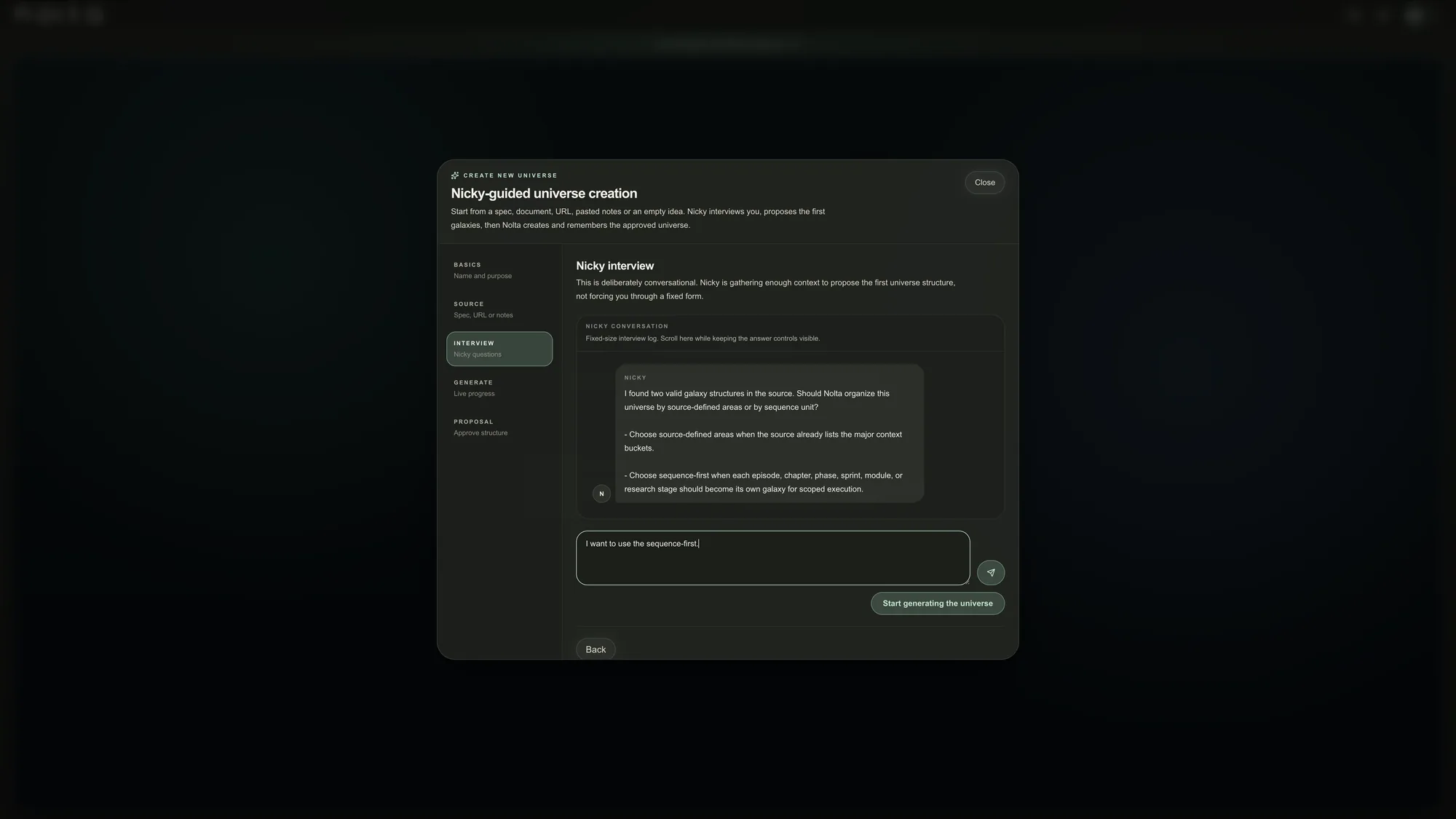
Example clarification
Should Nolta organize this universe by source-defined areas or by sequence unit?
Nicky should ask, not guess
A source can support more than one valid universe structure. A creative production may be organized by source-defined areas or by episode sequence. A research project may be organized by hypotheses or attempts. A software project may be organized by modules or release slices.
A good Blueprint makes those choices visible. Nicky can recommend a path, but the human approves the structure before Nolta creates the world.
Reusable patterns
Blueprints keep the Nolta core generic while making domain-specific context creation practical, repeatable and reviewable.
Turn a show bible, episode outline or game concept into a governed universe for scoped writing, production and review work.
Structure hypotheses, evidence, failed paths, attempts, findings and unresolved questions without losing the reasoning trail.
Translate modules, releases, risks, test evidence and implementation tasks into context AI can work from safely.
Create a living mission structure from plans, assets, dependencies, decisions, documentation and verification needs.
The simple version
Nicky uses it to create the first proposed universe. Nolta keeps using it to prepare context, guide work, require review and preserve the audit trail. Review before trust.